
Micro Teaching Skills Explained by Samad Shoeb: Complete Guide for Modern Educators
If you have ever watched a great teacher hold a room’s attention effortlessly, you have seen micro teaching skills in action, even if you didn’t know the name for it. Micro teaching skills are the small, specific abilities like questioning, explaining, or managing a classroom that make the difference between a lesson that falls flat and one that truly connects. In this guide, public speaking and leadership trainer Samad Shoeb breaks down what these skills are, why they matter, and how you can build them, whether you are a trainee teacher preparing for a B.Ed skill test or a corporate trainer trying to hold a room of adults.
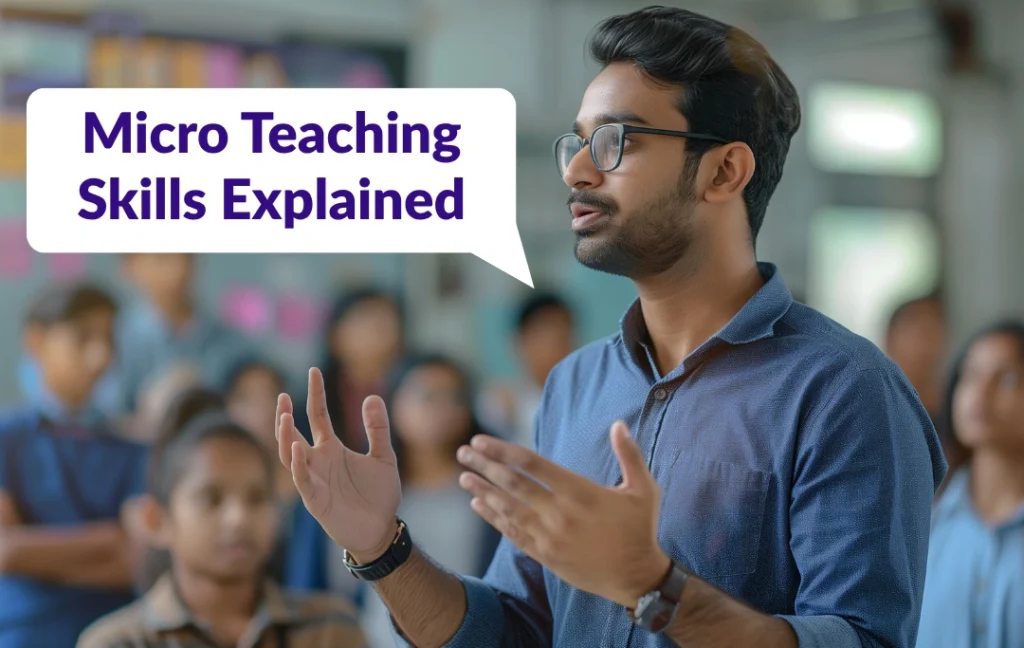
What Are Micro Teaching Skills?
So, what are micro teaching skills, exactly? In simple terms, they are the individual building blocks of good teaching. Instead of trying to “be a great teacher” all at once which is a huge, vague goal micro teaching breaks that down into small, practice-able pieces: how you ask a question, how you respond when a student gets something wrong, how you use your voice and body to keep attention, and so on.
This approach was developed in the 1960s at Stanford University, where trainee teachers would deliver short 5–10 minute lessons to a small group, get immediate feedback, and then try again. The idea was simple: it is far easier to improve one skill at a time than to fix “everything” at once.
Samad Shoeb explains it this way: “When I train someone in public speaking or leadership communication, I never tell them to ‘be more confident.’ That’s too broad to act on. Instead, I break it into one skill: eye contact, or pacing, or how they open a talk and we work on just that. Micro teaching applies the exact same logic to the classroom.”
Definition and Examples of Microteaching Skills
For a clear definition and examples of microteaching skills, think of each skill as a separate lever a teacher can pull to improve a lesson. Here are the most widely recognized ones:
1. Skill of Introduction
This is how a teacher opens a lesson connecting it to what students already know, and telling them what to expect. A weak introduction loses students in the first two minutes; a strong one hooks them immediately.
Example: Before teaching photosynthesis, a teacher might ask, “Have you ever wondered why leaves are green?” instead of jumping straight into definitions.
2. Skill of Questioning
Good questioning pushes students to think, not just recall facts. There are two common types:
- Probing questions — follow-up questions that dig deeper (“Can you explain why that happens?”)
- Divergent questions — open-ended questions with more than one valid answer
3. Skill of Explaining
This is about making a concept clear using simple language, relevant examples, and logical steps without overwhelming students with jargon.
4. Skill of Stimulus Variation
Attention naturally drifts, so effective teachers deliberately vary their voice, movement, gestures, and focus to pull students back in. This might mean moving around the room, changing your tone, or pausing for effect.
5. Skill of Reinforcement
This means responding to a student’s answer in a way that encourages them to keep participating in a nod, a “good thinking,” or gentle correction rather than dismissal.
6. Skill of Illustrating with Examples
Abstract ideas stick better when tied to something concrete, a real-world example, an object, or a simple demonstration.
7. Skill of Classroom Management
This covers everything from setting clear expectations to handling distractions calmly, so the lesson keeps moving without losing the room.
8. Skill of Using the Blackboard (or Digital Whiteboard)
Neat, well-organized visual notes help students follow along and retain information that applies just as much to a shared screen in an online class as it does to a physical blackboard.
9. Skill of Closure
Ending a lesson by summarizing key points, checking understanding, and linking to what comes next.
Skills Required for Effective Microteaching
Beyond the individual skills above, there are a few underlying skills required for effective microteaching as a training method itself:
- Self-awareness — being willing to watch your own recorded lesson honestly and spot what didn’t work
- Openness to feedback — treating peer or mentor feedback as data, not criticism
- Reflective practice — thinking through why something worked or didn’t, not just noting that it did
- Adaptability — adjusting your approach lesson to lesson based on what you learn
- Time management — since micro-teaching sessions are short, using every minute with intent
Samad Shoeb notes that this last point often gets overlooked: “In my own training sessions, the biggest improvement people make isn’t learning a new technique, it’s learning to actually sit with feedback instead of getting defensive about it. That mindset shift is what makes every other skill improve faster.”
Key Competencies for Micro Teaching Sessions
If you are preparing for a micro-teaching skill test, or simply trying to run better training sessions, here are the key competencies for micro teaching sessions examiners and mentors typically look for:
Competency | What It Looks Like in Practice |
Clarity of objectives | The lesson has one clear, specific goal |
Engagement | Students are actively involved, not passively listening |
Pacing | The lesson moves at a rhythm that matches the content’s difficulty |
Feedback responsiveness | The teacher adjusts mid-lesson based on how students react |
Use of voice and body | Tone, volume, and movement are used intentionally |
Content accuracy | The information taught is correct and age-appropriate |
List of Microteaching Techniques and Skills
To make this easier to reference, here is a quick list of microteaching techniques and skills you can use as a checklist:
- Skill of Introduction
- Skill of Questioning (probing and divergent)
- Skill of Explaining
- Skill of Stimulus Variation
- Skill of Reinforcement
- Skill of Illustrating with Examples
- Skill of Classroom Management
- Skill of Blackboard/Whiteboard Writing
- Skill of Closure
- Skill of Lesson Planning (the foundation all the others sit on)
You do not need to master all ten before your first attempt. Most trainee teachers pick one or two skills per micro-teaching session and build from there.
Micro Teaching Skills for Modern and Hybrid Classrooms
One thing older micro-teaching resources rarely cover is how these skills translate to online and hybrid teaching which is now a normal part of many educators’ and corporate trainers’ work.
- Stimulus variation online means using screen annotations, breakout rooms, or polls instead of just moving around a physical room.
- Classroom management online shifts toward managing chat activity, muting/unmuting, and keeping cameras engaged.
- Blackboard skill becomes about clean, well-organized slides or a shared digital whiteboard.
- Questioning in a webinar format often needs to be more structured, since you cannot always read the room the way you would in person.
Samad Shoeb, who regularly trains professionals in virtual sessions, adds: “The core skill doesn’t change, you’re still trying to hold attention and check understanding. What changes is the tool you use to do it. I’ve seen very experienced classroom teachers struggle online simply because they never adapted their stimulus variation techniques to a screen.”
Micro Teaching Skills for Corporate Trainers
Micro teaching isn’t only for B.Ed students. Corporate trainers, workshop facilitators, and public speaking coaches use the exact same skills just applied to adult learners.
- Introduction becomes setting context for why a topic matters to someone’s job
- Reinforcement becomes acknowledging good contributions in a meeting or workshop
- Explaining needs to respect that adults bring prior experience, so tying new concepts to what they already know matters even more
“When I coach executives on presentation skills, I’m essentially running a micro-teaching session with them,” says Samad Shoeb. “We isolate one skill, say, how they handle a tough question from the audience, practice it in a low-pressure setting, and build from there. It’s the same method, just a different classroom.”
Free Micro Teaching Skill Observation Checklist
To help you practice, here is a simple checklist you can use when observing your own or a peer’s micro-teaching session:
- Was the lesson objective clear within the first minute?
- Did the teacher use at least one probing question?
- Was there a visible change in tone, pace, or movement during the session?
- Did the teacher respond to student answers with reinforcement (positive or corrective)?
- Was an example or illustration used to explain the main concept?
- Did the session end with a summary or clear closure?
Conclusion
Mastering micro teaching skills is not about becoming a perfect teacher overnight it is about improving one small, specific ability at a time until those abilities add up to real classroom confidence. Whether you are a trainee teacher preparing for a skill test, an experienced educator adapting to hybrid classrooms, or a corporate trainer holding a room of adults, the same core skills apply: a strong introduction, thoughtful questioning, clear explaining, deliberate stimulus variation, timely reinforcement, and a confident closure. As Samad Shoeb puts it, the method works because it takes something as complex as “good teaching” and breaks it into pieces anyone can practice and improve. Start with one micro teaching skill from the list in this guide, use the checklist to observe your own progress, and build from there that is how lasting teaching competence is developed.
FAQs
Micro teaching skills are specific, individual teaching abilities such as questioning, explaining, stimulus variation, and classroom management that teachers practice and refine in short, focused sessions before applying them in a full classroom.
The most commonly taught skills include introduction, questioning, explaining, stimulus variation, reinforcement, illustrating with examples, classroom management, blackboard writing, closure, and lesson planning.
It breaks down the complex job of teaching into manageable parts, allowing trainee teachers to build confidence and competence one skill at a time, with immediate feedback, before managing a full classroom.
Yes. Corporate trainers, public speaking coaches, and workshop facilitators use the same underlying skills of questioning, reinforcement, stimulus variation to engage adult audiences in meetings, webinars, and training sessions.
Start by picking one skill, such as questioning or introduction, and practice it deliberately in a real or simulated session, a work presentation, a video you record of yourself, or a peer teaching exercise. Reviewing the recording and getting feedback is the core of the method, regardless of setting.