
Body Language Tips for Public Speaking That Actually Work
Here’s something most speaking coaches won’t tell you upfront: an audience decides whether it trusts you within the first seven seconds, and that call is made almost entirely by your body, not your words. You could walk in with the sharpest opening line in the room, but if your shoulders are hunched and your feet haven’t moved since you sat down, people will read nerves before they hear a single sentence of content. That’s really why body language for public speaking gets so much attention from coaches, TED speakers, and communication trainers.
It isn’t about performing confidence like an actor. It’s about clearing away the physical signals that quietly undercut a message you’ve already worked hard to prepare.
So let’s go through the habits that actually move the needle. Not the generic “stand up straight” advice you’ve heard a hundred times, but the specific things that change how an audience reads you the moment you step in front of them.
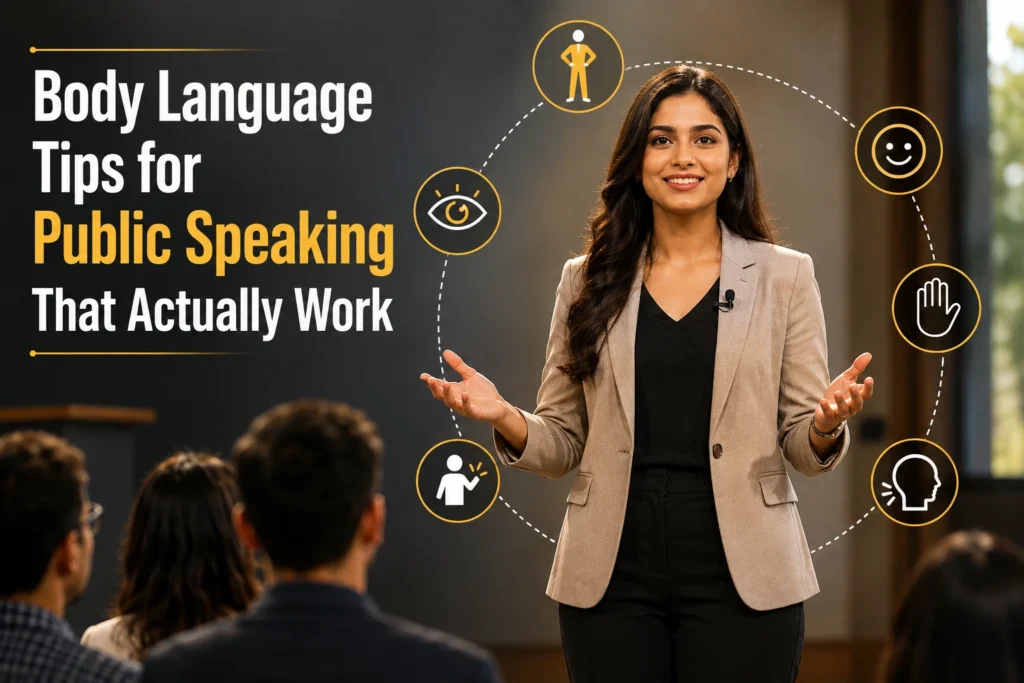
Why Body Language Matters More Than You Think
You’ve probably heard the claim that 93% of communication is nonverbal. That’s a misreading of Albert Mehrabian’s original research and it doesn’t hold up outside the narrow context he studied. But the underlying point still stands: when your words and your body are saying two different things, people believe the body first. A shaky voice paired with steady, grounded posture still reads as credible. A confident voice paired with crossed arms and a face that won’t meet anyone’s eyes reads as defensive, no matter how good the content is.
For a speaker, that means body language isn’t some soft extra you tack on at the end. It’s part of the message itself, whether you plan for it or not.
1. Ground Your Posture Before You Say a Word
Before you say anything, walk to the front, pause for a beat, and plant both feet roughly shoulder-width apart. It sounds almost too simple, but this one habit does two things at once it tells the room you’re composed, and it physically slows your breathing down, which calms nerves faster than most of the mental tricks people try instead.
Watch out for the two things that give nerves away without you realizing it: leaning your weight onto one hip, or that slight back-and-forth rocking some speakers fall into. Neither one is a conscious choice. They’re self-soothing movements, and audiences pick up on them even if they couldn’t tell you why something feels a bit off.
2. Use Eye Contact in Sections, Not Sweeps
New speakers are usually told to “make eye contact with the audience,” and what that turns into, more often than not, is a fast, robotic scan across the room that honestly looks worse than skipping eye contact altogether. Try this instead: split the room into three or four rough sections in your head, and hold eye contact with one person per section for a full thought — about three to five seconds before you move on.
Done this way, it feels like you’re talking to individual people rather than addressing a blur of faces out there, and it has a nice side effect too: it naturally slows your pace down, in the good way.
3. Let Your Hands Support the Words, Not Distract From Them
Your hands shouldn’t just be moving on autopilot while you talk. If you’re describing something growing, let your hands show that growth. If you’re contrasting two ideas, physically separate them in the space in front of you. Coaches sometimes call this “gesture congruence,” and it’s one of the quickest ways to come across as articulate rather than jittery.
Things to steer clear of: gestures that stay below the waist (they tend to read as fidgeting), the same chopping motion over and over, and hands buried in your pockets, which just takes an entire channel of expression off the table.
4. Move With Purpose, Not Out of Nervous Energy
Pacing back and forth is one of the easiest tells that a speaker is nervous, and audiences notice it even when they can’t explain what they’re seeing. But the fix isn’t to freeze in one spot either; a completely static speaker can feel just as disconnected as one who’s pacing. The better approach is to move only when you’re transitioning between ideas, then plant your feet again once you land on the point you’re making.
Do that consistently and movement starts doing real work for you: people subconsciously learn that when you move, a new idea is about to show up.
5. Relax Your Shoulders and Face Before You Begin
Tension shows up in the shoulders and jaw first, and honestly, it shows up on camera or on stage before you even feel it yourself. Right before you step up, roll your shoulders once and let your jaw hang loose for a second. Small thing, I know, but it visibly softens your expression and keeps you from getting that clenched, tight look that instantly reads as stress to anyone watching.
6. Match Your Facial Expression to Your Content
One thing that trips up a lot of new speakers is a flat, overly serious expression no matter what they’re saying usually a leftover habit from reading scripted material out loud in school. Your face should actually track what you’re saying: some concern when you’re describing a problem, warmth when you share a win, curiosity when you throw a question out to the room. This one adjustment alone often does more for keeping an audience engaged than any slide deck or prop you bring.
7. Control Nervous Habits by Naming Them First
Most people have no idea what their own nerves are, even twirling their hair, clicking a pen, adjusting glasses that don’t need adjusting. The fastest way around this is to record yourself giving a two-minute practice talk, then watch it back once with the sound off, paying attention purely to movement. You’ll spot the pattern almost immediately, and just becoming aware of it cuts the habit down a lot on its own.
8. Open Your Stance to Open the Room
Crossed arms, hands clasped tight in front of your body, standing angled sideways instead of facing the room, all of these quietly put up a barrier between you and the audience, even if you don’t mean them to. An open stance, chest toward the room, arms uncrossed, hands where people can see them, signals that you’re approachable, and it makes the audience more receptive before you’ve even made your first point.
9. Practice Body Language Under Real Pressure, Not Just in the Mirror
A mirror will show you what confident body language looks like, sure. What it won’t teach you is how to hold onto that body language once nerves kick in which is exactly when it matters most. Practicing in front of even one or two other people, or recording a full run-through and watching it back afterward, closes that gap much faster than rehearsing alone ever will. It’s part of why structured public speaking programs tend to outperform self-study when someone else catches the habits you simply can’t see in yourself.
A Quick Note From Experience
Samad Shoeb, founder of Oratrics, has trained thousands of students and working professionals through confidence-building and public speaking programs, and he keeps coming back to one observation: the students who improve fastest aren’t the ones memorizing a list of gestures. They’re the ones who fix just one or two specific habits usually posture or eye contact and let everything else fall into place once the nerves actually settle down. Body language isn’t something you perform off a checklist. It’s what naturally happens when you feel grounded, and that comes from repetition, not from theory.
Conclusion
Strong body language for public speaking really isn’t about acting confident. It’s about clearing out the physical noise that gets in the way of a message you’ve already put real work into. Start with posture and eye contact those two alone fix most of what reads as “nervous” to an audience. Once those feel natural, layer in intentional gestures and purposeful movement, and the rest tends to fall into place on its own with practice.
FAQs
Grounded posture and consistent eye contact matter most, since they’re the first two signals an audience reads before you even start speaking, and they set the tone for everything that follows.
Record yourself practicing and watch the playback with the sound off to spot your specific nervous habits, then rehearse in front of a small live audience so you can hold good body language under real pressure, not just in a mirror.
Yes. When body language and spoken words send conflicting signals, audiences tend to trust the nonverbal cues first, which is why posture, gestures, and facial expression carry as much weight as word choice in a speech.
It can absolutely be learned. Most confident-looking speakers built that skill through structured practice and feedback, not natural talent, which is the basis of most public speaking coaching programs.