
How to Overcome Stage Fear: Complete Guide by Public Speaking Coach Samad Shoeb
Sweaty palms before a client call. A shaky voice halfway through a team update. That blank moment when everyone’s looking at you and your brain just… stops. If any of this sounds familiar, you already know how much stage fear can get in the way of your work. Here’s the part that usually surprises people: how to overcome stage fear isn’t some talent you either have or don’t. It’s a skill, and it’s one you can build at any point in your career, no matter how long you’ve been avoiding the mic.
I’m Samad Shoeb, and I run Oratrics, where I coach public speaking and business communication. Over the years I’ve sat across from hundreds of professionals — junior team members, first-time managers, people who’d been in leadership roles for a decade — who all said some version of the same thing: “I’m just not a natural at this.” Almost none of them were right. What was actually missing wasn’t talent. It was a process. This article walks through that process, in plain terms, for people who need to present, pitch, or lead a room without falling apart doing it.
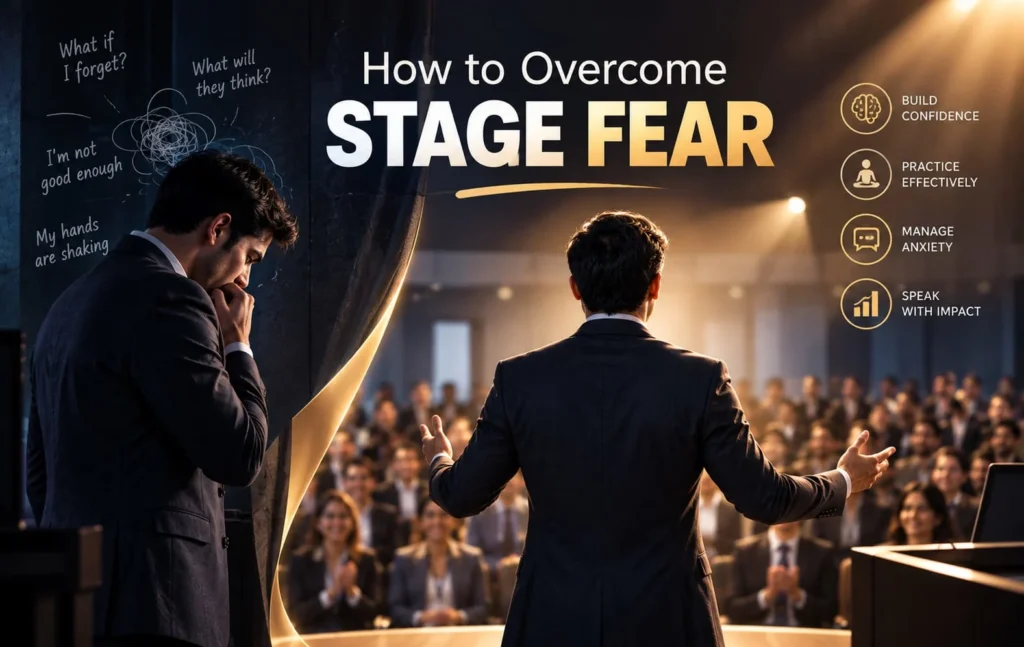
What is Stage Fear, and Why Does It Affect Professionals So Much?
Stage fear, sometimes called stage fright or performance anxiety, is really just your body treating “being watched” as a threat. The moment attention shifts to you — ten colleagues in a meeting room, or a few hundred people at a conference, your nervous system reacts the way it would to any perceived danger. Heart rate climbs. Palms sweat. Thoughts speed up or, sometimes, vanish entirely.
For working professionals, this tends to show up in a handful of familiar scenarios:
- Presenting numbers or project updates to leadership
- Pitching a client or an investor
- Speaking up in meetings, even small, low-stakes ones
- Running a team training session or a town hall
- Interviewing for a promotion or a new job
None of these are one-time events. They come back around, month after month, year after year which is exactly why it’s worth learning ways to get over stage fright now rather than later. Every bit of effort you put in pays off again and again.
Why Willpower Alone Doesn't Work ?
Most people try to muscle through stage fear by just telling themselves to calm down, and it rarely holds up. Stage fear isn’t something you can talk yourself out of in the thirty seconds before you speak, it’s a physical and mental pattern that has to be retrained over time. Ironically, “don’t be nervous” tends to make the nerves louder, not quieter.
The techniques below work because they hit three different layers at once: how you prepare beforehand, what you do with your body and breathing in the moments right before speaking, and how you think about the whole experience. Most of the “quick fix” advice floating around only touches one of these three, which is exactly why it fades after a day or two.
Techniques to Overcome Stage Fear as a Professional
1. Prepare With a Structure, Not Just Content
Here’s a mistake I see constantly: people polish their slides for hours and barely think about how they’ll actually deliver the talk. Knowing your content matters, but it’s not enough on its own. Before any presentation, sketch out a loose structure: an opening line, three main points, a closing statement. When you know the shape of what you’re saying instead of trying to recall exact wording, you’ve got mental bandwidth left over to handle the nerves instead of scrambling for your next sentence.
This kind of structural prep is one of the more reliable tips for overcoming stage fright before a presentation, mainly because it removes the biggest anxiety trigger there is: not knowing what comes next.
2. Rehearse Out Loud, Not Just in Your Head
Reading your notes silently feels productive, but it’s not the same as actually rehearsing. Your brain needs to practice the physical act of speaking, shaping the words, catching your breath, hearing your own voice out loud before it can do that comfortably under pressure. So stand up, say it out loud, and do it at least three times before anything important. Record one of those run-throughs and watch it back. Most people are far harder on themselves in playback than any real audience would ever be.
3. Use Breathing Techniques to Calm Your Nervous System
If you’re wondering how to reduce nerves before performing live, this is probably the fastest answer. Try this right before you walk into the room:
- Breathe in slowly through your nose for a count of 4
- Hold it for a count of 4
- Breathe out slowly through your mouth for a count of 6
Do that three to five times. The longer exhale is what does the work. It activates your parasympathetic nervous system, which brings your heart rate down and eases the physical symptoms: shaky hands, tight chest, that racing pulse feeling.
4. Reframe the Anxiety Instead of Suppressing It
One of the more counterintuitive techniques to beat performance anxiety isn’t about getting rid of the nervousness at all, it’s about calling it something else. There’s decent research on this: telling yourself “I’m excited” instead of “I’m nervous” actually improves performance, because excitement and anxiety feel almost identical in the body. Your system is already revved up either way. Reframing just changes how your mind reads that signal.
5. Shift Focus From Yourself to Your Message
A big chunk of stage fear comes down to self-focus worrying about how you sound, how you look, what people are thinking of you. The quickest way to break that spiral is to point your attention outward, toward what you’re actually giving your audience. Before you start, ask “what does this room need from me?” instead of “what will they think of me?” That one shift alone answers how can I stop being nervous on stage for a lot of the professionals I’ve worked with, because it takes the spotlight off you and puts it on the message.
6. Start With a Strong, Rehearsed Opening
Nerves peak in the first thirty seconds, almost every time. If your opening lines are rehearsed enough to be automatic, you can coast through the hardest part of the talk on muscle memory while the nerves settle down on their own. One thing to avoid: don’t open with an apology (“sorry, I’m a bit nervous today”). It draws attention to the exact thing you’re trying to manage, and it usually makes the audience more critical, not less.
7. Practice in Front of Real People, Not Just a Mirror
Rehearsing alone in your room helps to a point, but it doesn’t recreate the actual pressure of being watched. Before something big, run through it with a colleague, a friend, or family member, and actually ask for honest feedback. Slowly increasing how often you’re watched by one person first, then a small group is one of the most durable ways to get over stage fright long-term, because it teaches your nervous system that being observed isn’t dangerous.
8. Slow Down Your Pace Deliberately
Nerves make people talk faster, and talking faster makes people sound more nervous. It’s a loop that feeds itself. Deliberately slowing down, especially in your opening sentences, sends a signal of control both to the room and to your own nervous system. Leave pauses after your key points too. A pause always feels longer to you than it does to anyone listening, and to them it usually just reads as confidence.
9. Focus on Friendly Faces in the Room
Before you start talking, scan the room and pick out one or two people who look engaged or supportive. Speaking to them here and there through the talk, instead of trying to make eye contact with everyone at once, makes the whole thing feel more like a conversation than a performance under a spotlight.
10. Build Exposure Gradually Instead of Avoiding Speaking Opportunities
This is probably the single biggest reason stage fear sticks around into senior roles: avoidance. Every time you skip speaking up in a meeting or pass on a presentation, the fear gets a little more reinforced, not less. Instead, look for smaller, lower-stakes chances to practice speaking up once in a small meeting, volunteer for a short update and build from there. This gradual approach is backed by decades of anxiety research, and it holds up far better over time than any single trick ever will.
Common Mistakes Professionals Make When Trying to Overcome Stage Fear
- Leaning too hard on notes instead of internalizing a structure, which backfires badly if you lose your place mid-talk
- Avoiding speaking opportunities instead of practicing in smaller, lower-stakes settings first
- Trying to erase the nerves entirely, when the more realistic goal is just managing them
- Skipping physical prep breathing, posture and putting all the effort into content instead
- Comparing yourself to polished speakers, without remembering that most of them built that skill through years of repetition, not natural talent
When to Consider Working With a Coach
A lot of professionals get real results just from practicing on their own. But if stage fear is actually costing you something, a promotion, client trust, visibility with leadership working with a coach can speed things up considerably. A good coach spots the specific habits you can’t see yourself, like rushed pacing or filler words or quiet avoidance patterns, and gives you feedback far faster than solo practice ever could.
Conclusion
Learning how to overcome stage fear doesn’t mean turning into a fearless speaker overnight, and honestly, that’s not really the goal. It’s about building something you can rely on every time you step in front of a room: solid preparation, a calmer body, a shifted mindset, and steady practice. Every confident speaker you’ve ever admired started out exactly where you are right now. The only real difference is that they kept showing up and doing it anyway.
FAQs
Most professionals notice a real difference within 4 to 8 weeks of consistent practice, though it depends a lot on how often you actually get chances to speak and practice in between.
Not really, and that’s fine even experienced speakers feel some nerves before going on. The goal isn’t zero nervousness, it’s managing it so it doesn’t take over your performance.
Slow breathing in for 4 counts, out for 6 is probably the quickest way to physically settle your nervous system in the minutes before you speak.
No. Stage fear is usually limited to performance situations, while social anxiety shows up in everyday social interactions more broadly. You can have one without the other.
Not automatically, but the stakes can feel bigger in senior roles, which sometimes makes existing stage fear more noticeable. The same techniques still work regardless of where you are in your career.