

What Is Managerial Grid Theory of Leadership? Meaning, 5 Styles, Examples & Applications
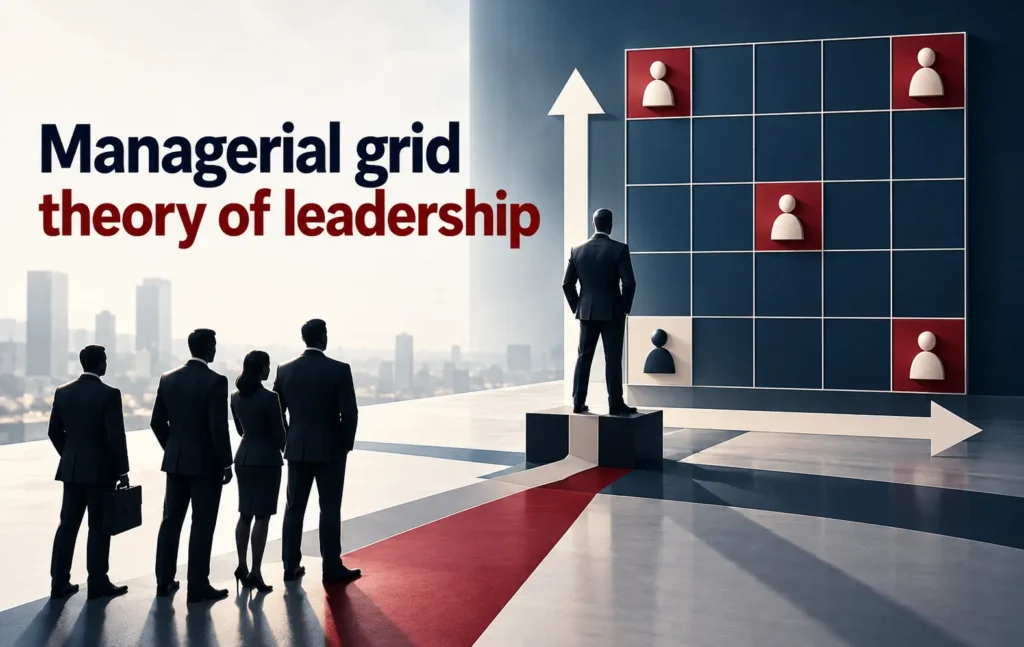
The managerial grid theory of leadership is a behavioral leadership model that describes a manager’s style using two dimensions: concern for people and concern for production. Developed by Robert R. Blake and Jane S. Mouton, the managerial grid model plots both dimensions on a 1-to-9 scale, which produces five main managerial grid leadership styles: impoverished, country club, produce-or-perish, middle-of-the-road and team management.
What Is Managerial Grid Theory of Leadership?
The managerial grid theory of leadership is a framework for describing and improving how managers lead. Instead of asking what kind of personality a leader has, it looks at what a leader pays attention to: the people doing the work, the work itself, or both.
The model was created by Robert R. Blake and Jane S. Mouton, American management scholars and consultants. Its purpose is practical: to help managers see their own habits, compare them with a clear ideal, and develop toward a more balanced style.
Leadership behavior vs. leadership effectiveness. The grid describes behavior, meaning what a manager tends to do and prioritize. It does not by itself prove that a style is effective in every situation. Blake and Mouton argued that the 9,9 style produces the best long-term results, but later research on leadership has shown that effectiveness also depends on the task, the team and the organization. Keeping the two ideas separate helps you use the grid as a reflection tool rather than a verdict.
Two Main Dimensions of the Managerial Grid Model
Every position on the grid is defined by two concerns.
Concern for People
Concern for people describes how much a leader cares about the individuals who do the work: their well-being, trust, motivation, growth and working relationships.
A manager with a high concern for people listens to employees, recognizes effort, supports development and creates a safe environment to raise problems. For example, a school principal who checks in on teachers’ workload and supports their professional growth shows strong concern for people.
Concern for Production
Concern for production describes how much a leader cares about results: goals, efficiency, quality, deadlines and output. Here, “production” does not only mean factory output. It can mean sales, student results, project delivery or service quality.
A manager with high concern for production sets clear targets, tracks performance and works to remove obstacles to output. A sales manager who monitors weekly revenue against quota is showing concern for production.
The 1 to 9 Scale
Both dimensions are rated on a scale from 1 (low) to 9 (high). A position is written as two numbers, with concern for production first and concern for people second, for example (9,1) or (1,9). The middle of the scale is 5.
These numbers represent a manager’s orientation. They are a helpful way to talk about style, but they are not precise, scientifically validated measurements of leadership effectiveness.
Managerial Grid Theory of Leadership Diagram Explained
The managerial grid is a square with nine steps on each side.
- Horizontal axis (x): Concern for Production, from 1 (low) on the left to 9 (high) on the right.
- Vertical axis (y): Concern for People, from 1 (low) at the bottom to 9 (high) at the top.
The five traditional styles sit at the four corners and the center:
Concern for People (y)
9 | Country Club (1,9) Team Management (9,9)
|
7 |
|
5 | Middle-of-the-Road (5,5)
|
3 |
|
1 | Impoverished (1,1) Produce-or-Perish (9,1)
+—————————————————————-
1 2 3 4 5 6 7 8 9
Concern for Production (x)
How to read the grid:
- Top-left: people come first, results are neglected.
- Bottom-right: results come first, people are neglected.
- Bottom-left: little attention to either.
- Center: a moderate compromise on both.
- Top-right: high commitment to both, the model’s ideal.
Positions between the corners are also possible. A manager at (7,4), for instance, leans toward production with some attention to people.
Infographic brief: Draw a 9×9 grid. Label the x-axis “Concern for Production” and the y-axis “Concern for People”. Place the five named styles at the coordinates above, using a distinct color for each. Add a one-line description under each label.
Five Leadership Styles of Managerial Grid Theory
1. Impoverished Management (1,1)
Definition: The leader shows low concern for both people and production and does the minimum needed to keep their position.
Characteristics:
- Avoids decisions, conflict and responsibility
- Provides little direction or feedback
- Is rarely involved in the team’s work
2. Country Club Management (1,9)
Definition: The leader has high concern for people but low concern for production. Harmony and friendliness are prioritized over results.
Characteristics:
- Warm, supportive and approachable
- Avoids criticism and difficult conversations
- Sets lenient targets
3. Produce-or-Perish Management (9,1)
Definition: Also called authority-compliance management, this style has high concern for production and low concern for people. Results come first, and people are treated mainly as a means to achieve them.
Characteristics:
- Strict control and close monitoring
- Top-down decisions with little consultation
- Emphasis on rules, deadlines and output
4. Middle-of-the-Road Management (5,5)
Definition: The leader balances moderate concern for people with moderate concern for production, accepting adequate performance and acceptable morale.
Characteristics:
- Seeks compromise between demands and satisfaction
- Avoids extremes and bold changes
- Keeps things stable and “good enough”
5. Team Management (9,9)
Definition: The leader shows high concern for both people and production, and believes work goals are best achieved through committed, involved people who share a common purpose.
Characteristics:
- Open communication and mutual trust
- Shared goals and participative decision-making
- High standards combined with genuine support
Managerial Grid Theory of Leadership With Examples
The scenarios below are original, hypothetical illustrations created to explain the model. They are not verified real-world case studies.
Example 1: A School Principal
A principal wants better exam results. In the first version of the story, the principal posts targets, demands weekly reports and ignores teachers’ concerns about workload. This is Produce-or-Perish (9,1). Scores may rise briefly, but teacher turnover and resentment can grow.
In the second version, the principal meets teachers to agree on realistic goals, arranges training and mentoring, and reviews progress regularly. This is closer to Team Management (9,9). Results are more likely to improve steadily because teachers feel supported and committed.
Example 2: A Corporate Team Leader Handling Deadlines
A team leader is managing a software release. If they stay out of the details, avoid status meetings and let the deadline slip without comment, they are acting as an Impoverished (1,1) manager. Deadlines are missed and the team lacks direction.
If they hold a short planning session, divide the work fairly, check in regularly and adjust the plan when problems appear, they are operating nearer to Team Management (9,9), and the release is more likely to be on time with fewer conflicts.
Advantages of Managerial Grid Theory
- Simple and easy to understand. The two-axis diagram makes leadership style easy to visualize and teach.
- Encourages self-assessment. Managers can plot themselves on the grid and see where they tend to lean, for example realizing they over-focus on deadlines.
- Highlights both people and goals. It reminds leaders that results and relationships are connected, not opposites.
- Supports leadership training. Trainers can use the grid to structure workshops, 360-degree feedback and coaching conversations.
- Helps managers reflect. Naming a style makes it easier to discuss and change.
- Gives a practical foundation for discussion. Teams and HR can use shared language to talk about management expectations.
Disadvantages and Limitations of Managerial Grid Theory
The model is useful but not complete. A balanced view includes these limitations:
- Limited consideration of situations. The grid does not systematically account for task type, team maturity or urgency. Contingency approaches such as Fiedler’s model and Hersey and Blanchard’s situational leadership address this gap.
- Simplification of complex behavior. Reducing leadership to two dimensions leaves out vision, ethics, communication, emotional intelligence and more.
- Cultural and organizational differences. What counts as concern for people, or an acceptable level of directness, varies across cultures and industries.
- Difficulty measuring objectively. Scores often depend on self-reports or subjective ratings, which can be biased.
- Limited predictive power. A position on the grid alone does not reliably predict whether a leader will succeed.
- The assumption that 9,9 is always best. Blake and Mouton promoted Team Management as the ideal, but research has not shown that one style is superior in every context.
Applications of Managerial Grid Theory in Modern Organizations
- Leadership development programs. Companies and business schools use the grid in workshops to help managers identify their default style.
- 360-degree feedback. Colleagues and team members can rate a manager on both dimensions, giving a fuller picture than self-assessment.
- Hiring and promotion discussions. HR teams can use the dimensions to discuss what a role needs, such as stronger people skills for a manager who delivers results but loses staff.
- Education. School leaders and department heads can reflect on balancing teacher support with academic performance.
- Remote and hybrid teams. The grid is a reminder that clear goals (production) and regular, human contact (people) both need deliberate attention when teams are not in the same room.
- Coaching and mentoring. Coaches can use the grid to set concrete development goals, such as moving from 9,3 toward 9,7.
How to Move Toward Team Management (9,9)
- Plot yourself honestly. Ask peers and direct reports for feedback on both dimensions.
- Clarify goals together. Agree on targets and how they will be measured.
- Build trust. Listen, follow through and be consistent.
- Give regular, balanced feedback. Recognize good work and address problems early.
- Adapt to context. Be more directive in emergencies and more empowering as the team grows.
FAQs
It is a model that describes a manager’s style by how much they care about people and how much they care about results, each rated from 1 to 9.
Robert R. Blake and Jane S. Mouton developed it in the early 1960s and published it in 1964.
Impoverished (1,1), Country Club (1,9), Produce-or-Perish (9,1), Middle-of-the-Road (5,5) and Team Management (9,9).